After a car accident or another type of accident, it can be difficult to regain your health, your feelings of confidence, or even your ability to feel safe. Many are understandably shaken dealing with the physical and mental repercussions of serious injuries in addition to uncertainty about their financial future. If you are involved in an accident that has resulted in personal injury to you, it is important that you consider filing a personal injury claim.
Through a personal injury lawsuit, you can recover financial compensation for your losses, including property damage, lost wages, medical bills, pain and suffering, and more. There are several steps that you can take before consulting with a lawyer in order to protect your rights and your well-being, from seeking medical treatment to taking pictures and videos of the accident scene. Once you are able to do so, you can speak with a Long Island personal injury attorney, to gain insight on your best course of action and prevent any issues that could result in a lowered compensation amount.
The Odierno Law Firm represents accident victims throughout Long Island, including Suffolk County and Nassau County. We offer free initial consultations and never charge a fee unless we recover money for you. To learn more or to schedule an appointment with a Long Island car accident lawyer, give our law offices a call today.
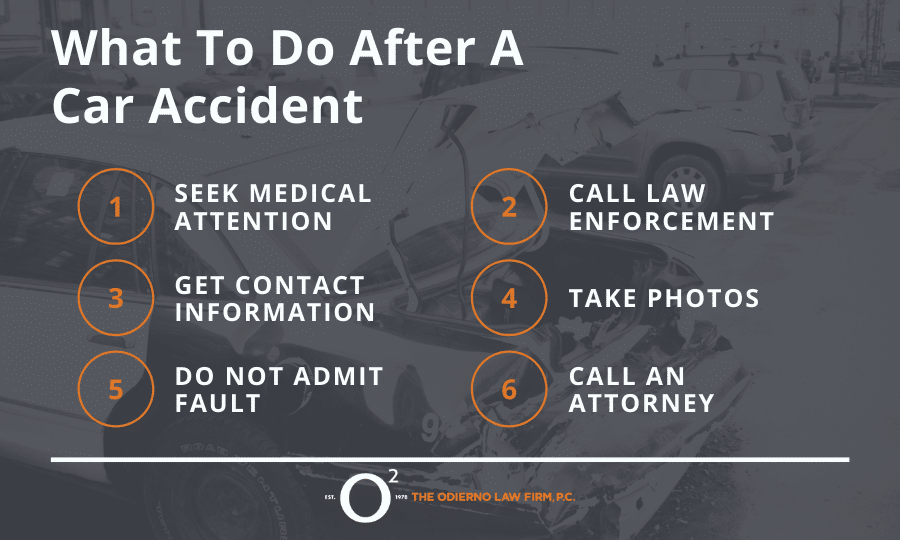
Steps To Take After a Car Accident
Immediately after a motor vehicle accident, you might be dazed, in shock, and experiencing a lot of pain. It can be hard to think straight, let alone figure out what the right thing to do is. Fortunately, taking a few steps after an auto accident can significantly increase the likelihood of recovering maximum compensation for your losses.
Step #1: Call emergency services or seek medical care right away.
The first and most important step is to receive the proper medical care. Even if you believe that you may not be seriously injured, it is best to have yourself evaluated by a doctor. In many cases, the pain from an injury does not show up until hours or even days later. This will not only ensure that the car accident injuries are assessed and treated, but it will also provide immediate medical documentation which will later be helpful when you file a claim.
In many personal injury claims, the insurance company will try to argue that an accident victim’s injuries were pre-existing or that they weren’t that serious. By getting medical treatment right away, you are establishing a link between the crash and your injuries. These medical records can be used to prove the extent of your injuries and may be an important part of your claim for compensation.
Step #2: Call law enforcement and report the accident.
If you have been injured in a car accident, it is important to report it to the police. In some types of accidents, it is not necessary to report to the police. However, promptly reporting that the accident has occurred can provide you with documentation of the accident. An MV4 accident report – as they are known in New York – can serve as important evidence from an objective source (law enforcement) of the facts of your claim.
However, when talking to police, you should stick to the facts, such as “I was stopped at the red light when the other driver struck me from behind.” It is extremely important to never give any details in any type of report as to why you think that accident occurred or whether or not you believe you may have been partially at fault. Insurance companies may use these types of details – like saying that you were distracted – as a way to deny liability.
Step #3: Get information from the other driver
If another driver was involved in the crash, then you should exchange contact and insurance information with them. You should also take down their license plate information.
While talking to the other driver and anyone else at the scene, do not admit fault. It is natural to want to apologize or say “I’m sorry,” even if you didn’t cause the accident. Try to only say as much as necessary – like your name, contact information, and insurance info.
Step #4: Get the names and contact information of witnesses.
In most types of accidents, it is important to get the names of anyone that may have witnessed the accident. This could be a co-worker, bystander, or simply someone walking down the street at the time of the accident. You can also note if there are any cameras at nearby businesses that may have recorded what happened.
Witnesses often play a crucial role in car accident claims. The other driver may have a different recollection than yours or may flat-out lie to avoid liability. A neutral third party who witnessed the accident can provide testimony during discovery and/or at trial that supports your version of events.
Step #5: Take photos and videos.
For better or for worse, we live in a time where most people have smartphones on them at all times. After a car accident, you can use your phone or a camera to take photos and videos of the accident scene, your vehicle, the surrounding areas, and your injuries. The photos may be used as evidence at a later date and could back up your claim.
Step #6: Write down what happened.
Once you get home, write down what occurred. Try to be as specific as possible also, noting the weather, the area, how you feel, and what you remember. Over time, your memory may fade – particularly when it comes to a traumatic accident. Contemporaneous notes about the accident can be a good way to reconstruct the events of the days, weeks, or even months in the future.
Step #7: Do not talk to the other driver’s insurance company or sign any paperwork.
After an accident, you will likely be approached by an adjuster for the at-fault driver’s insurance company. They may tell you that they accept liability, ask you to sign paperwork, or even offer you a settlement. While it may be tempting to take the money and move forward, doing so would be a mistake.
Insurance companies are in business to make money. No matter how nice the adjuster may seem, they are not on your side. Their goal is to get you to say or do something that will undermine your claim.
Step #8: Do not admit fault.
After an accident, it is natural to want to take the blame even when it is not true. The period after a serious accident is emotional and in many cases, very confusing as to what actually occurred. It is natural to feel guilty, even when you are not at fault, as this is often part of human nature. Unfortunately, the responsible party or insurance companies may use your apology to keep from paying you your just compensation. Refrain from discussing the accident if at all possible.
Step #9: Speak with a Long Island personal injury attorney immediately.
Speak with a personal injury lawyer as early on in the process as possible. If you wish to speak with an attorney before reporting the accident to your insurance company, you may do so. An attorney will greatly improve your chances of receiving fair compensation for your injuries.
Remember: the insurance company does not have your best interests at heart. The best way to get full compensation for your losses is to work with an experienced Long Island personal injury attorney. They can help you file a car accident lawsuit and will fight for your right to a fair settlement.
Why Is It So Important to Talk to a Car Accident Lawyer?
Many people do not realize the hardship that medical bills and other expenses from the accident can cause until the situation gets serious, with bills piling up and a limited ability to pay. Unfortunately, this too often leads to lowered credit and bankruptcy. There is a short amount of time in which you may file a claim, so it is best to have your claim reviewed as soon as possible. If you are unsure as to whether you have a case, the best thing to do is have a Long Island car accident attorney review the details of the accident.
Studies show that people who are represented by counsel recover an average of 40% more than people who represent themselves in personal injury lawsuits. In other words, you cannot afford to not hire a lawyer if you have been hurt in a car accident.
Insurance companies will do everything in their power to resolve a car accident claim for as little money as possible – or to deny it outright. They will often make lowball settlement offers, hoping that an accident victim will take the money without realizing that they are entitled to much more. In many cases, the full extent of a person’s injuries and losses aren’t known for months or even years after a crash.
In a personal injury case, you may be entitled to financial compensation for all of your losses. This may include three types of damages: economic, non-economic, and punitive. Economic and non-economic damages compensate an injury victim for their losses, while punitive damages punish a wrongdoer who acted intentionally or recklessly.
Economic damages pay for direct financial losses, such as lost wages, reduced earning capacity, medical bills, property damage, and future medical treatment. Non-economic damages pay for intangible losses – which can be harder to prove but are no less important. Examples of economic damages include pain and suffering, emotional distress, scarring, disfigurement, and loss of enjoyment of life. Finally, punitive damages may be awarded in cases where the at-fault driver acted intentionally or recklessly, such as a drunk driving accident.
Insurance companies often focus exclusively on the first category of damages – economic losses. While it is critical to get paid for these losses, they are not the only type of damages that you may be entitled to under New York law. By consulting with a Nassau County car accident attorney as soon as possible after your accident, you will increase the likelihood of getting full compensation for your injuries.
The best way to protect your interests after a motor vehicle accident is to consult with a lawyer. With free initial consultations, you have nothing to lose and everything to gain by talking to an attorney before making any decisions or talking to an insurance company. In Suffolk County and beyond, you can count on The Odierno Law Firm to advocate for your best interests and show you how to get the accident settlement you deserve.
Connect with Our Car Accident Attorneys in Long Island
Accidents can happen to anyone, even the most careful drivers who follow all the safety rules and the law. In some tragic cases, lives are lost, or an innocent person is left with lifelong, serious injuries. Wading through the system in order to get the compensation you deserve can be daunting.
Insurance companies are notorious for all the following:
- Offering inadequate settlements
- Delaying payment
- Challenging claims
- Overall making the process difficult
Don’t be a victim of the process. The team at The Odierno Law Firm, P.C. is highly skilled in helping the injured recover the compensation that is deserved and is here to help you at every step. If you’d like to schedule a free consultation with one of our car crash attorneys, give our law offices a call at 631-752-8580 or fill out our online contact form.
How Long Do I Have to File a Car Accident Lawsuit in New York?
The statute of limitations for most personal injury claims in New York is 3 years. With a few exceptions, this means that you have 3 years from the date of the accident to file a claim. If you fail to do so, then your claim will likely be thrown out of court.
3 years may seem like a long time, but it can go quickly when you are dealing with doctor’s appointments and other issues related to a car accident. Contacting a Long Island car accident attorney as soon as possible after the crash is the best way to protect your rights. Reach out to The Odierno Law Firm today to schedule a free consultation with a member of our legal team.
How Can I Afford to Hire an Attorney?
Car accident cases – and other types of personal injury claims – are typically handled on a contingency fee basis. This means that you pay nothing upfront, and will only pay a fee if your lawyer recovers money for you through a settlement or verdict at trial. The fee that you pay will be a percentage of your total recovery.
Contingency fee agreements ensure that anyone can hire a lawyer, even if they don’t have extra cash on hand to pay an hourly fee. If you have been hurt in a car accident, call The Odierno Law Firm to talk to an experienced Long Island car accident lawyer today.
Do I Really Need a Lawyer for a Long Island Car Accident Case?
You are not required to hire an attorney to handle your claim; you are free to resolve your claim directly with the at-fault party’s insurance company. However, in almost every case, doing so would be a mistake.
Unless you were in a very minor car accident with no injuries, the settlement offered by the insurance company will likely be for far less money than you are entitled to – or that you need to fully recover. A lawyer will build a strong case and advocate for your right to full compensation. In Suffolk and Nassau counties, call The Odierno Law Firm to schedule a free initial consultation with a Long Island car accident attorney.
Dedicated To You
We are committed to getting you the compensation you deserve for the injuries you have sustained. We are determined to fight for you. We have a no recovery, no fee policy, so you don’t pay unless we win.
Why Us?
 You Will Not Pay Us Unless We Win Your Case
- Our Firm is Backed By Trial Success & Client Satisfaction
- We Will Review Your Personal Injury Claim For Free
- We Have Over 150 Years of Combined Legal Experience
 You Will Not Pay Us Unless We Win Your Case